
Hypersonic Aerodynamics in Rarefied Flow Regimes
Rarefied aerodynamics begins where the classical continuum assumption starts losing validity. At sufficiently high altitudes and supersonic or hypersonic speeds, the molecular mean free path becomes comparable to the characteristic length scale. The flow description therefore shifts from continuum gradients to molecular-level interactions. In this regime, velocity distributions move away from equilibrium, internal energy modes relax at different rates, and shock waves no longer remain thin discontinuities, but finite regions with internal structure. (Ivanov et al.; Boyd)
Shock Structure in Rarefied Hypersonics
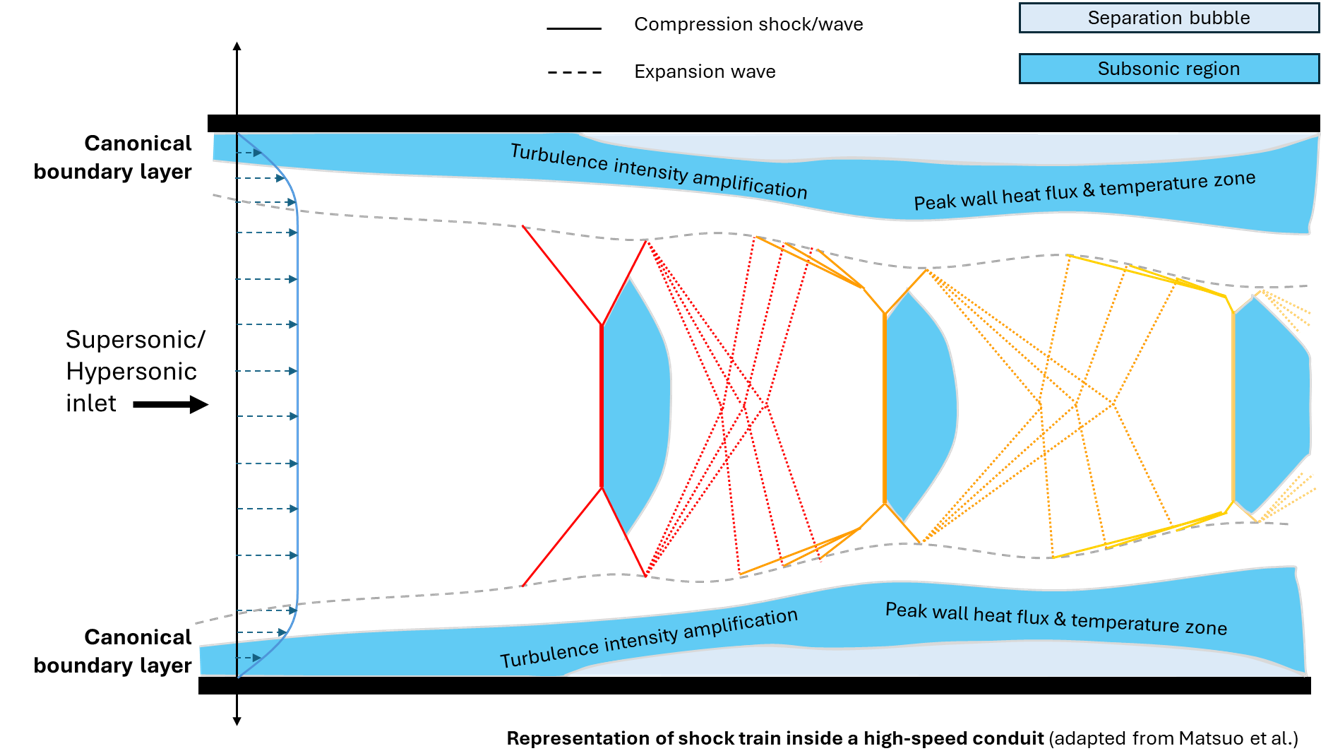
This becomes important when rarefaction is coupled with hypersonic shock physics. Shock waves still exist, but their thickness scales with the molecular mean free path. This changes how shocks interact, reflect, and redistribute energy. Classical shock-shock interaction patterns gradually change with increasing rarefaction, with reduced energy concentration and lower amplification of localized pressure, shear and heat flux. (Jiang et al.)
Experimental studies also show the same trend. In rarefied supersonic flow, even simple interacting bodies show modified shock structures and interference patterns. Wake interaction, shock merging, and resulting force and heat-transfer behaviour differ from the continuum case, making kinetic and viscous effects important to capture together. (Cardona et al.)
Flight System Implications
This has direct relevance to upper-atmosphere flight, re-entry, debris evolution, and high-altitude hypersonic systems. Vehicles in these regimes pass through continuum, slip, transitional and free-molecular flow conditions. Aerodynamic control, stability and thermal loads are therefore influenced by rarefaction, and Navier-Stokes based assumptions alone may not be sufficient across the full trajectory. Kinetic approaches such as DSMC, built on the Boltzmann framework, become necessary for high-fidelity prediction. (Boyd; Zuppardi et al.)
Rarefied aerodynamics is not separate from hypersonics. It is a regime where gas dynamics, molecular physics, aerothermal loading and trajectory prediction start becoming tightly coupled. For future high-altitude and re-entry systems, understanding this coupling is essential for reliable design.
References:
Ivanov et al. : https://lnkd.in/euZ5pDXD
Iain D. Boyd : https://lnkd.in/e-sdZcPy
Jiang et al. : https://lnkd.in/eDhPwi7u
Cardona et al. : https://lnkd.in/eagN66GH
Zuppardi et al. : https://lnkd.in/eEWnF8wy
Image credit: ESA (IXV re-entry vehicle)
